
What are they, and why do they matter?
We all know that taste is the main reason we gravitate toward certain foods or drinks. But beyond flavour, mouthfeel plays a starring role in building taste. Mouthfeel is the texture and sensations you experience when consuming food and beverages. This includes how food looks, tastes, sounds and feels in your mouth.
It is one key reason we either accept or reject what we eat. In summary; Mouthfeel, alongside flavour, creates the full experience of eating, impacting not just how food tastes, but how it feels in our mouths – critical factors for keeping consumers happy.
Visual textureEven before we put food in our mouths, we can already see that it is shiny, or rough, or that it looks grainy. If we think about a pudding, the height on the spoon corresponds to its mounding; which is also a visual texture cue. | Tactile sensationsMouthfeel includes the tactile aspects of texture perception during food consumption. It refers to what a person feels in the mouth. For example, how much does the yogurt coat your mouth? Is it firm or slippery? Is it sticky or chalky? | Audible sensationsMouthfeel also includes the audible sensations of food. For example. the loudness of the sound of biting into a cracker. |
Reformulating a favourite or developing a new product; the process always impacts Mouthfeel. No matter what the goal is – healthier options, innovative sensations, cleaner labels or better value – that consequence is inevitable. And if it’s not addressed consumers may reject your product. So the challenge and opportunity is clear: always prioritise Mouthfeel and you gain the advantage.
Creating outstanding tastes, textures and sensory experiences requires both science and skill. Ingredient choices need to balanced with an understanding of synergies and interactions. Our expert team can deliver this, unlocking huge opportunities for your brand to succeed.
Introducing our innovative tool for Mouthfeel formulation. Following a simple 3-step process, we can help you create superior product experiences, in a quicker and easier way.
Insight: Our team map what consumers of a given geography and category want.
Translate: We translate their language around desired mouthfeel into scientific sensory lexicon.
Solution: Together, we build a unique toolkit of solutions that deliver the most loved attributes.
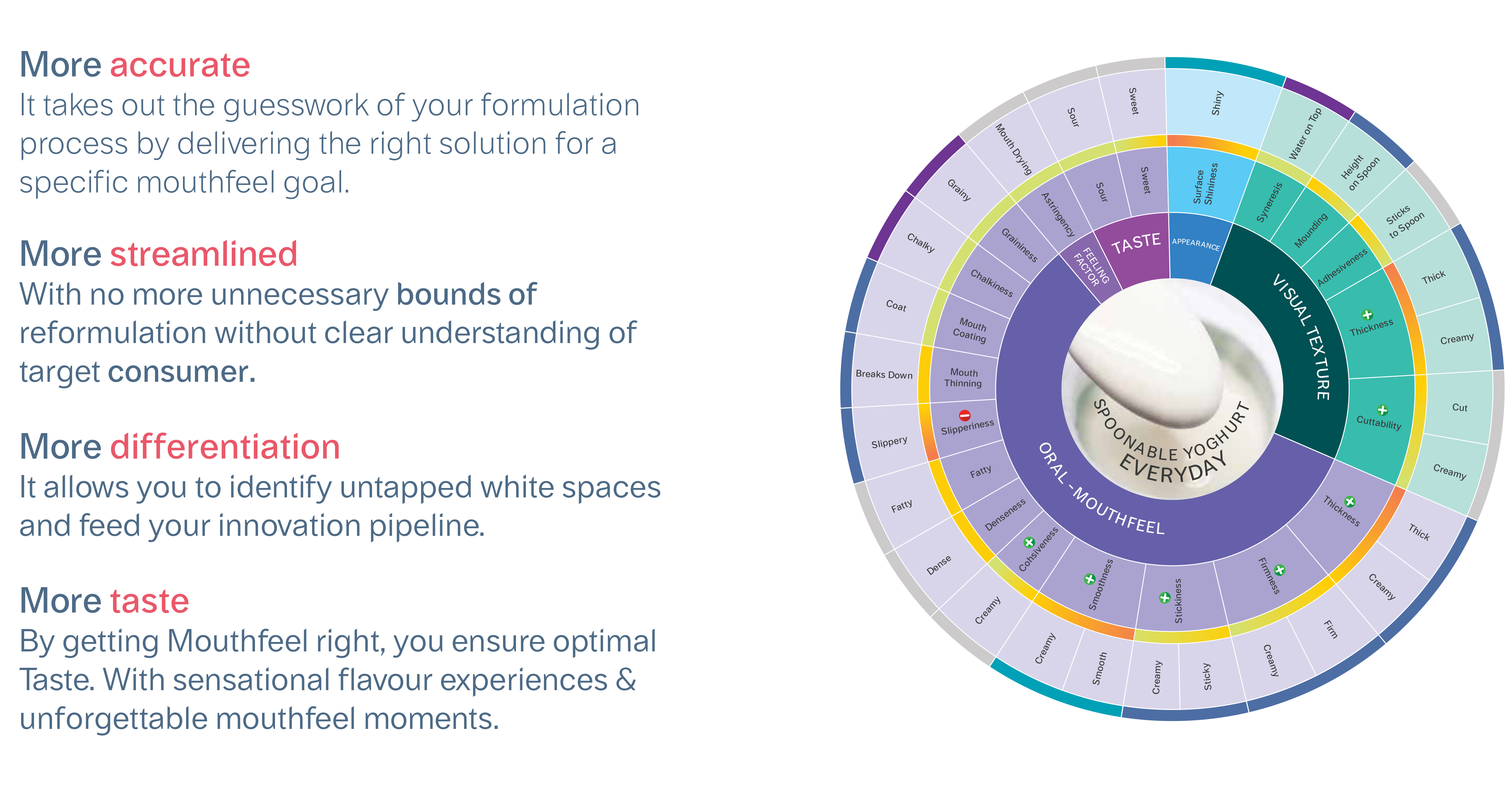
Solution spotlight
Taste and mouthfeel are key for consumer liking. So we take three different approaches to formulation, always keeping mouthfeel in mind. Each one is tailored to your goals, and all are designed to deliver delicious results. Just let us know what you want to achieve.
We help you optimise and reduce costs to create more profitability in your brand. All while retaining your product’s mouthfeel and critical functionality (body, viscosity, stability).
- Cost-down formulations
- Efficiency gains
- Ingredient switching without performance loss
- Longer shelf-life
We reformulate with a focus on retaining Mouthfeel for healthier products, cleaner labels, regulatory expertise or consumer needs such as being sugar-free or vegan.
- Sugar-free formulation
- Fat-free formulation
- Animal-free formulation
- Non-GMO formulation
- Regulatory expertise
Our team innovate new product development, elevating sensorial attributes (creamier, crunchier) or creating new textures that provide exciting experiences using proprietary consumer insights like our Future of Mouthfeel report.
Consumer excitement
Elevated sensorial experience
Heightened texture performance
Unique insights and research
With expert support and an extensive ingredient portfolio spanning fibres, sweeteners, starches, hydrocolloids and more, we can find the right solution for any goal.
Thickening starches
Gelling starches
Film formers
Clean-label starches
Pectin
Carrageenan
Xanthan gum
Gellan gum
Locus bean gum
Allulose
Maltodextrin
Corn soluble fibre
FOS/GOS
Polydextrose
Citrus fibre
Chickpea flour
Chickpea protein
Microparticulated whey protein concentrate
- Functional blend systems
Case studies, insights & resources



With our unique insights, unparalleled mouthfeel science and industry leading portfolio we can use our mouthfeel mastery to make your product truly stand out on shelf.
Frequently Asked Questions
Mouthfeel is the texture and sensations experienced when consuming food or beverages. It includes how a product looks, tastes, sounds and feels in the mouth. Alongside flavour, it shapes the complete eating or drinking experience and strongly influences consumer acceptance.
Mouthfeel includes visual, tactile and audible cues. Consumers may notice shine, roughness, graininess or mounding before tasting; coating, firmness, slipperiness, stickiness or chalkiness in the mouth; and sounds such as the snap or crunch of a cracker. These cues work together to create product perception.
Because mouthfeel is a key component of Taste, and Taste is the number one factor influencing consumer purchase and re-purchase. Developing a new product or changing an existing recipe almost always changes mouthfeel. If the new sensory experience does not match consumer expectations, the product may be rejected even when its flavour or nutrition is strong. Addressing mouthfeel early gives formulators a better chance of protecting liking and satisfaction.
Tate & Lyle focuses on retaining the critical sensory attributes that consumers expect in a given product category (such as shininess in yogurt and crunchiness in snacks) while pursuing goals such as sugar-free, fat-free, animal-free, non-GMO or cleaner-label formulation. The team evaluates ingredient interactions and regulatory needs to build a solution around the whole sensory experience.
Yes, and this represents a big opportunity to make the cost-reduction reformulation more succesful. Tate & Lyle helps formulators reduce costs, switch ingredients and improve efficiency while protecting the product's taste profile, including texture and mouthfeel Other considerations kept in check for cost optimisation reformulations are shelf life, functionality and performance.
Mouthfeel can be used to elevate attributes such as creaminess or crunch, create new textures and deliver more exciting sensory experiences. Tate & Lyle combines product-development expertise with consumer insights, including its Future of Mouthfeel research, to help brands design distinctive texture experiences.
Tate & Lyle Sensation™ is a mouthfeel formulation tool built around a three-step process. The team maps the most liked or disliked sensory attributes s in a given category and geography , translates consumer language into a scientific sensory vocabulary, and then builds a tailored toolkit of solutions designed to deliver the most-loved attributes.
Tate & Lyle's mouthfeel portfolio spans starches, hydrocolloids, sweeteners, fibres, proteins, functional flours and functional blend systems. Featured options include thickening and gelling starches, pectin, carrageenan, xanthan and gellan gums, soluble and citrus fibres, chickpea ingredients and microparticulated whey protein concentrate.
Yes. Tate & Lyle uses mouthfeel expertise for healthier formulations, sugar and fat reduction, vegan and other animal-free products, non-GMO needs and cleaner labels. The formulation is tailored so that the chosen health, label or value objective does not unnecessarily diminish the sensory experience.
Consumers describe desired experiences in everyday terms such as creamy, crunchy, silky or satisfying. Tate & Lyle translates those descriptions into measurable sensory attributes, identifies the necessary ingredient functions and synergies, and builds a formulation toolkit around the target experience, category and market.
The information provided in this document is to the best of our knowledge, true and accurate at the time it is given. It is provided to customers for its information and internal use only. Tate & Lyle is not liable for any damage that may result from the misuse of this information