
When it comes to GLP-1 formulations it’s easy to get stuck in an outdated mindset and make the mistake of focusing purely on low-calorie or “diet” foods that often compromise on taste. Consumers today are seeking a new, very intentional relationship with what they eat and drink. One that is defined by satisfaction, not restriction. That means great eating and drinking experiences that deliver both on preferred taste and nutritional support needs. Success means formulating for sustainable habits, health-forward and tasty products that are already emotionally integrated into their day parts.
If you only cater to the segment of consumers currently using GLP-1 you’re missing the big picture. Our research makes it very clear that GLP-1 consumers, and their needs, are not defined as a single segment; we found three distinct groups with different needs. Support is needed both on and off the medication, alongside those consumers who haven’t tried, or won’t ever try, GLP-1 medications.
Current GLP-1 users"I'm eating less, so I want what I do have to be nutritious but also bring me joy”
| Former GLP-1 users"I want to maintain my success, still enjoy food but need help to feel fuller”
| GLP-1 Non-users"I want success on my own terms, but I still need nutritious options to satiate me”
|
For each GLP-1 user group we have established a clear hierarchy of consumer needs, mapping relative importance.
Hierarchy of Need Differences & Considerations: Beyond Active GLP-1 Use
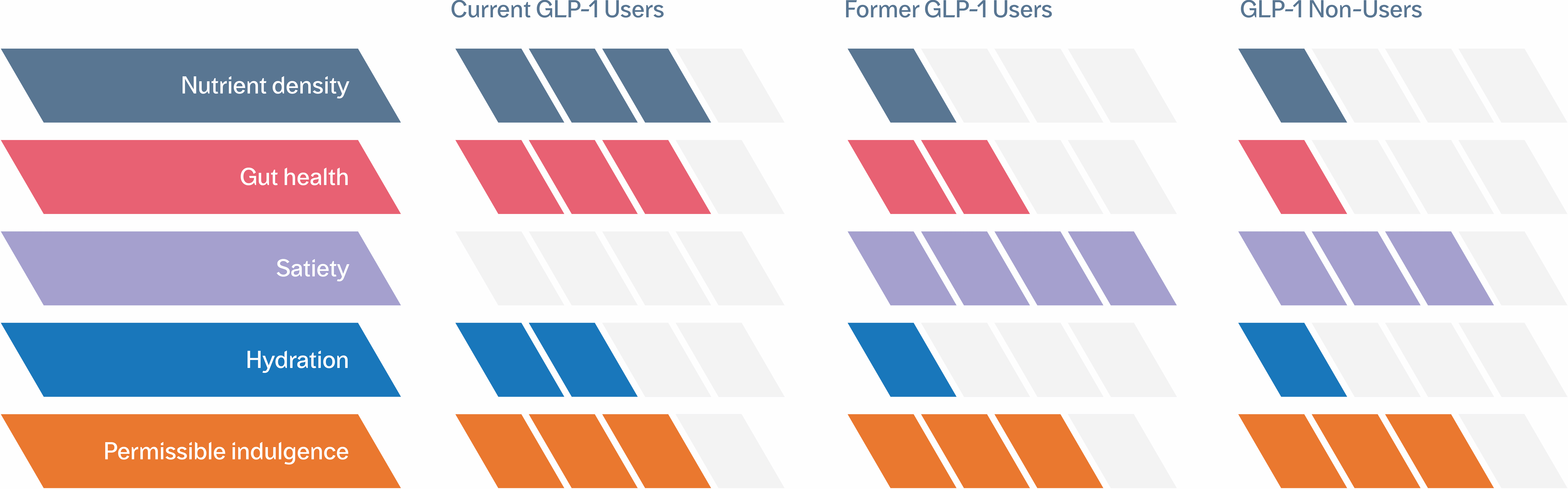
With this framework we can create different solutions that appeal to each consumer type. For example: GLP-1 helps deliver satiety. So, it’s not a priority for active users. But for former and non-users controlling cravings is the top motivator. By tailoring the emphasis on each of our 5 different consumer needs in formulations we can create the solutions that consumers really want – driving trial and enabling lifelong healthy habits.
Formulating for success



Solution Spotlight
With expert support and an extensive ingredient portfolio spanning fibres, sweeteners, starches, hydrocolloids, functional blend systems and more, we can find the right solution for any goal.
A great solution for adding proven health benefits, with easy to digest and well-tolerated prebiotic fibre (65g daily) that can enable fibre-forward formulations. It also offers low glycaemic response, gut health benefits, and improved calcium absorption for bone health. It’s easy to formulate with, offering high solubility and a variety of formats with excellent stability in application.
A great soluble fibre to help consumers feel fuller for longer on less calories. It is a well-tolerated prebiotic fibre (90g daily) that supports satiety. It is easy to formulate with and can replace the functionality of a glucose syrup or sweetener solids, with huge nutritional advantages. It can be easily used across for a wide range of categories, with great taste, texture and health benefits.
FOS (Fructo-oligosaccharides) is a soluble dietary fibre that’s recognised as being prebiotic. It’s found in many plants, is low in calories, provides a sweet taste and is easy to process. Its functionality and processing attributes include low heat and acid stability.
Our GOS (galacto-oligosaccharides) products are made from a chain of galactose sugars generally derived from lactose. Recognised as a prebiotic it can be applied in functional foods and fortified dairy products, including yoghurts.
An easily recognizable and consumer-friendly solution that brings back Mouthfeel in sugar-reduced beverages. Derived from citrus peels, a byproduct of the juice industry, GENU® Pectin may support gut health in adults 4
We provide a full range of stevia solutions; a plant-based sweetener that contributes zero calories, does not raise blood sugar and is 200 to 300 times sweeter than sugar.
Tastes and functions like sugar, but has over 90% fewer calories. Replicates many of sugar’s functional benefits: it adds bulk and texture, depresses the freezing point, and browns when baking.
Our proprietary high potency sweetener derived from sucrose. Sucralose (600 times sweeter than sugar but without the calories) maintains sweetness through a wide variety of food processing conditions, pH levels and over a long shelf life.
The increase in GLP-1 usage has an impact across every category of the food and beverage industry. Across all of them; we’re here to help.
Our ingredients deliver the varying health benefits, taste preferences and nutritional priorities that different GLP-1consumer groups truly need and want. Leveraging our consumer insights and sensory research, we can provide the roadmap to GLP-1 success.
In the confectionary category our sweetening ingredients and texturants are vital to creating the permissible indulgence that our GLP-1 consumer research highlighted. We can create products that feel like you’re treating yourself, without compromising on nutritional goals.
Hydration is critical for all GLP-1 users. Our team can formulate beverages that deliver this, while also providing support with weight management and digestive health, alongside low, or no, sugar content.
In yoghurt applications we enhance fibre levels with minimal impact on calories, to match the expectations of GLP-1 users. Fibre is differentiator that consumers seek in this category, looking for digestive and bone health benefits and support. Our fortification expertise enables formulations that are both label and gut friendly.
GLP-1 users increasingly seek out specific nutritional products when shopping. Our capabilities and ingredients allow for multiple formulation approaches in this space, creating products that offer the signs of GLP-1 friendliness consumers look for; added fibre and gut health claims.4
When choosing snacks, GLP-1 users are looking to reduce fat and sugar, while also being conscious of calories. Our market-leading Mouthfeel capabilities mean we can recreate the taste and textures that give consumers a satisfying snacking experience without compromising on those nutritional considerations.

Don’t miss out on the positive wave of health reformulation and innovation GLP-1 usage has created. We can help you formulate with the right balance of health, deliciousness and convenience, so you can offer consumers the meaningful nutritional support and satisfaction they seek.
Frequently Asked Questions
GLP-1 has increased interest in healthier formulations and more intentional food choices. The opportunity is to offer solutions that meaningfully improve consumer health and are backed by nutrition science. Tate & Lyle's research points to products that support sustainable habits, are enjoyable to consume and fit naturally into consumers' established day parts.
The needs connected with GLP-1 extend beyond people currently using the medication. Tate & Lyle's research identifies current users, former users and non-users as distinct groups, each with different priorities. Formulating for this wider landscape can create more relevant products for consumers on and off medication, as well as those who may never use it.
Current users are focused on nutrient-dense foods that still bring food joy and permissible indulgence. Former users place greater emphasis on satiety and sustaining results, while non-users seek nutritious, satisfying options on their own terms. Tate & Lyle maps these differences into a hierarchy of needs that can guide formulation priorities.
Consumers are looking for satisfaction, not restriction. A product may contain fewer calories, but it still needs preferred taste, an enjoyable sensory experience and added nutritional support. Formulations that feel emotionally integrated into everyday routines are better aligned with the sustainable habits Tate & Lyle's GLP-1 research describes.
Fibre can support different priorities across the consumer groups. Tate & Lyle's fibre portfolio can support digestive health and support managing side effects for current users, while fibre fortification can help deliver satiety for former users. Prebiotic benefits are for everyone. The formulation goal is to add nutritional support and health benefits without compromising taste or performance.
Tate & Lyle's research indicates that controlling cravings is a leading motivator for former users and non-users. Soluble-fibre solutions such as STA-LITE® Polydextrose can support fullness with fewer calories and reduced intake at the next meal while also contributing functional benefits in application and further prebiotic benefits. The precise solution should be tailored to the category, nutritional target and desired eating experience.
Permissible indulgence matters across all three consumer groups. Tate & Lyle's sweetener portfolio can deliver the sweet taste consumers enjoy without the calories and glycaemic spikes associated with sugar. Its research also considers how sweetness perception and preferences may differ throughout GLP-1 usage. Sweeteners and mouthfeel are important enablers of a healthier diet.
Enjoyment depends on more than nutrition alone. Tate & Lyle uses proprietary sensory research to understand differences in taste perception and mouthfeel preferences among current, former and non-users. Those insights help the team optimise formulations for the sensory experience, satisfaction and health priorities relevant to each group.
The featured portfolio includes PROMITOR® Soluble Fibre, STA-LITE® Polydextrose, EUOLIGO® FOS, GOSYAN® GOS, GENU® Pectin, Tate & Lyle Stevia, DOLCIA PRIMA® Allulose and SPLENDA® Sucralose. These ingredients address different needs across fibre fortification, prebiotic benefits, satiety, sweetening, mouthfeel and sugar functionality.
Tate & Lyle combines a three-group consumer framework, a hierarchy of five needs, sensory research, nutrition science and an extensive ingredient portfolio. This gives formulators a roadmap for deciding which benefits and sensory attributes to emphasise for each audience, rather than treating GLP-1 consumers as one uniform segment.
1 Benefits may be dosage and application dependent. Please consult your local regulatory expert before making any product claims. Details of studies cited in support of these benefits available from your technical sales support.
2 The health benefits (excluding ‘source of fibre’ and ‘weight management’) are based on clinical trial evidence and may not be substantiated health claims. Regulations might allow similar claims at different amounts and regulations differ by region.
3 Effects shown in specific populations. Prebiotic effects of PROMITOR and GOS are shown in healthy adolescents. Bone health effects of GOS and PROMITOR are shown in healthy adolescents and postmenopausal women. Mineral absorption effects of PROMITOR, FOS, and GOS are shown in healthy adolescents and postmenopausal women
4 Reference available upon request
Prospective purchasers are advised to conduct their own tests, studies and review of the intellectual property and regulatory space to determine the fitness of Tate & Lyle products for their particular purposes, product claims or specific application